
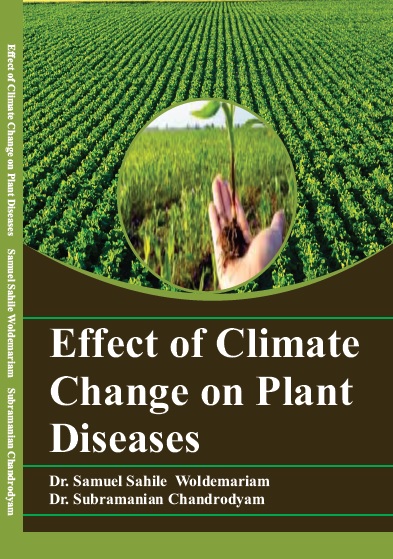
EFFECT OF CLIMATE CHANGE ON PLANT DISEASES

Dr. Samuel Sahile Woldemariam
Author / Research Scholar
About the Author(s)
Samuel Sahile Woldemariam awarded Bsc (In Biology), Msc (in Microbiology) from Addis Ababa University and again graduated from Haramaya University in July, 2009 with PhD in Plant pathology and currently working as an Associate Professor of Plant Pathology and Applied Microbiology at College of Natural and Computational Sciences, and Director of Postgraduate Studies, University of Gondar. In the carriers involved in many research and community activities, publishing more than 35research articles and advisor for more than 60 post graduate students.
Synopsis & Scholarly Abstract
Now a day most of the important plant diseases worldwide are highly adaptable to climatic variables causing crop loss and may result significant economical damages. Some of them are highly virulent and even cause 100% crop loss. These effects are difficult to dissect and model as their mechanistic bases are generally poorly understood. Nevertheless, a combination of integrated modeling from different disciplines and multifactorial experimentation will advance our understanding and prioritization of the challenges. Climate change affects components of complex biological interactions differentially, often causing changes that are difficult to predict. Crop yield and quality are affected by climate change directly, and indirectly, through diseases that themselves will change but remain important. Pathogens are very dependent on environment for disease development. Pathogens often exist at low levels but erupt into epidemics rapidly under favorable conditions. This book is intended to provide comprehensive information about “Climate change and the Effect of plant disease causing microorganismsâ€. It will be one of the rare books available so far to the readers that deciphers the information about the climate change and plant diseases. It is useful to the students of climatology, agriculture, crop protection, plant pathology, environmental biology, micro biology and other biological sciences of all colleges and universities. Any comments and suggestions from the readers are welcomed and will be incorporated into the next edition.